
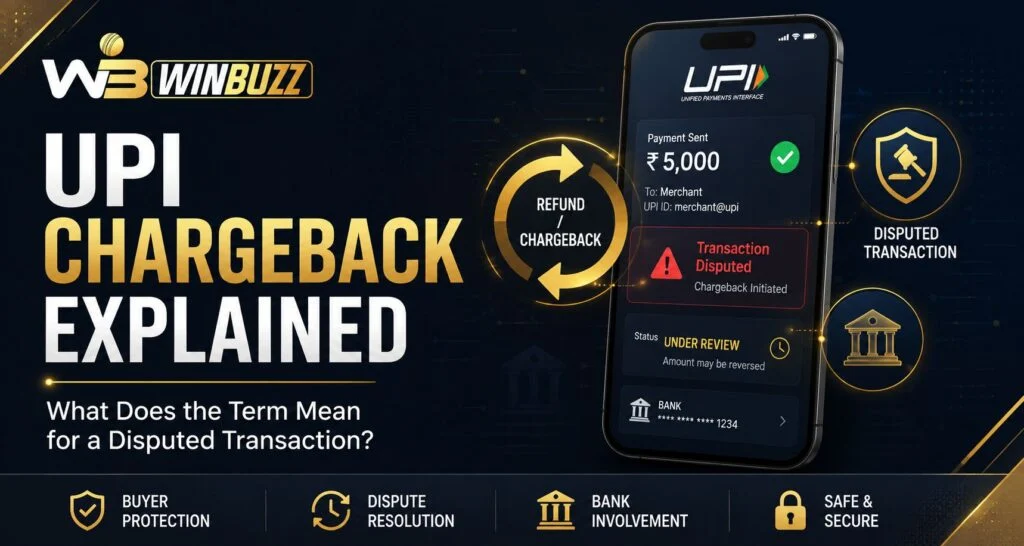
UPI payments usually happen within seconds, but occasionally a transaction may become disputed because of a failed payment, incorrect credit, suspected unauthorized activity or another payment issue. For Winbuzz users, the term “chargeback” can sound as though money is automatically pulled back from the recipient. In practice, it generally refers to a formal dispute and adjustment process within the payment system, and the outcome depends on the transaction circumstances and applicable rules. NPCI itself uses chargeback terminology in its UPI back-office framework, including for fraud and wrong-credit cases.
What Is a UPI Chargeback?
A UPI chargeback is best understood as part of a formal transaction-dispute process. It may be initiated when a payment needs investigation and a participant believes that an adjustment or reversal is required under applicable UPI rules.
It is important to distinguish a chargeback from simply pressing a “cancel payment” button. UPI is designed as a real-time payment system that transfers money directly between participating bank accounts.
After a Winbuzz Login, users who notice a payment discrepancy should therefore first identify the actual transaction status instead of assuming that every disputed payment can immediately be reversed.
Chargeback vs Refund: What Is the Difference?
The terms are often confused, but they describe different situations.
Refund
A refund generally occurs when a merchant or recipient voluntarily sends money back after an original transaction.
Chargeback or Formal Dispute
A chargeback involves a dispute that may require review by banks or payment-system participants before an adjustment is made.
The important difference is that a refund is normally initiated directly as a new return of funds, while a disputed transaction goes through an investigation or grievance process.
For Winbuzz App users, seeing a payment problem does not automatically mean that a chargeback has already been approved.
Why Might a UPI Transaction Be Disputed?
Different situations can lead someone to raise a UPI complaint.
Examples may include:
- Money debited but the transaction showing failed
- Payment credited to an unintended recipient
- Duplicate transaction concerns
- Suspected unauthorized transactions
- Merchant payment disputes
- Transaction status not matching the account balance
NPCI provides a UPI dispute-redressal mechanism where users can check transaction status and raise complaints about payment-related problems.
Winbuzz Com users experiencing any discrepancy should preserve the transaction details before starting the complaint process.
Is a Failed UPI Transaction the Same as a Chargeback?
No.
RBI defines a failed transaction as one that was not fully completed because of reasons not attributable to the customer, such as communication problems or other technical issues. RBI has also established turnaround-time rules for resolving specified failed digital transactions.
A failed payment may therefore qualify for an automatic reversal under applicable rules without requiring the same kind of disputed-transaction process associated with a chargeback.
Before using a Winbuzz ID to make another payment, users should check whether the original transaction is:
- Successful
- Failed
- Pending
- Reversed
- Under dispute
Repeating a payment while the first transaction remains uncertain can create additional confusion.
What Happens After a UPI Dispute Is Raised?
The exact process depends on the type of complaint, participating banks and the payment issue involved.
A review may involve checking:
- UPI transaction reference
- Payer bank records
- Beneficiary bank records
- Transaction timestamp
- Payment status
- Merchant information
- Nature of the complaint
RBI requires payment-system operators to provide an online dispute-resolution framework for digital-payment disputes, initially covering failed transactions and allowing complaints to be handled through system-driven processes.
Winbuzz Login users should therefore keep the original payment reference instead of relying only on screenshots.
Does Raising a Chargeback Guarantee a Refund?
No. Raising a dispute does not automatically mean that funds will be returned.
The transaction must be reviewed according to the applicable rules and evidence. Possible outcomes may include:
- Transaction confirmed as valid
- Automatic reversal completed
- Dispute accepted
- Dispute rejected
- Additional information requested
For users accessing the Winbuzz App, this is why a “complaint raised” status should not be interpreted as “refund approved.”
What Details Should Users Keep?
Keeping accurate records can make it easier to explain a disputed transaction.
Useful information includes:
- UPI transaction ID
- Date and time
- Amount
- Recipient or merchant name
- Bank transaction reference
- Current transaction status
- Relevant screenshots
Winbuzz ID users should never share their UPI PIN when discussing a complaint. NPCI specifically advises users not to share their UPI PIN and notes that bank customer support should not ask for it.
Where Should a UPI Complaint Be Raised?
NPCI states that UPI users can raise grievances through participating UPI applications, and its official UPI Help service also supports transaction-status checks and complaints.
If a complaint against a regulated bank or payment-system participant is not satisfactorily resolved through the normal grievance process, RBI also provides its complaint-management mechanism for eligible cases.
Winbuzz Com users should use official banking and payment-support channels rather than unknown links received through messages.
Conclusion
A UPI chargeback is not simply an instant cancellation of a completed payment. It belongs to a broader dispute and adjustment process used when a transaction requires investigation. Some failed transactions may instead receive automatic reversals under applicable payment rules.
For Winbuzz users, the safest approach is to check the payment status, preserve the UPI reference number and raise the issue through official UPI or banking channels. Understanding the difference between a refund, reversal and disputed transaction can make payment problems much easier to interpret.
FAQs
What does UPI chargeback mean?
It generally refers to a formal dispute process through which a transaction may be reviewed for an adjustment or reversal.
Is a UPI chargeback the same as a refund?
No. A refund is generally returned voluntarily by a merchant or recipient, while a chargeback involves a formal dispute process.
Does raising a UPI dispute guarantee that money will be returned?
No. The complaint must be reviewed, and the outcome depends on the circumstances and applicable payment rules.
What should I do if money is debited but the UPI transaction fails?
Check the transaction status and applicable reversal period first. RBI has prescribed turnaround-time rules for specified failed digital transactions.
What information should I keep for a UPI dispute?
Keep the transaction ID, amount, date, bank reference, payment status and relevant screenshots.
Should I share my UPI PIN with customer support?
No. A UPI PIN should never be shared with anyone, including someone claiming to be customer support.


