
Introduction
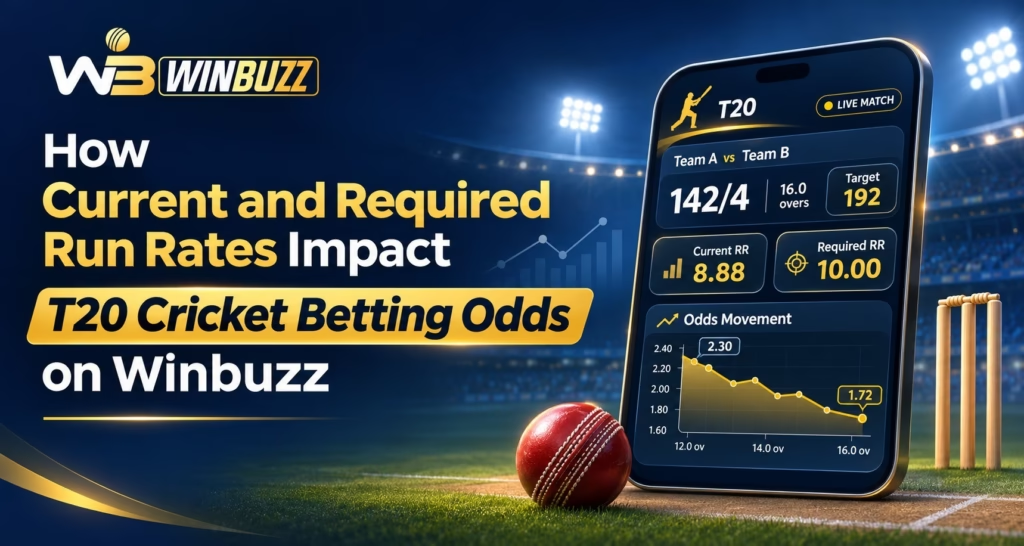
Current run rate describes how quickly a team has scored, while required run rate shows the pace needed to complete a chase. When reading T20 odds on Winbuzz, comparing these figures can help explain changing match expectations.
A rising required rate can increase pressure on the chasing side, potentially lengthening its win odds. However, wickets, batting resources, conditions, and remaining deliveries also matter. Here is how to calculate both rates and interpret them alongside the match situation.
Current Run Rate: The Scoring Pace So Far
Current run rate, or CRR, measures the average runs scored per completed over-equivalent.
CRR = Total runs × 6 ÷ Legal deliveries faced
For example, 90 runs from 60 legal deliveries gives a CRR of 9.00. This describes past scoring, rather than predicting future runs.
Why Over Notation Matters
A score after 8.3 overs means eight overs and three legal deliveries, or 51 balls. It does not mean 8.3 decimal overs.
If a team has scored 85 from those 51 balls, its CRR is 10.00. Dividing 85 by 8.3 would produce an incorrect answer.
Using legal deliveries keeps calculations clear when wides or no-balls occur: runs can increase without the remaining legal-ball count decreasing.
Required Run Rate: The Pace Needed to Win
Required run rate, or RRR, measures how quickly the chasing team must score from its remaining deliveries.
RRR = Runs still needed × 6 ÷ Legal deliveries remaining
Suppose the target is 181 and the chasing side reaches 90 after ten overs. It needs another 91 from 60 balls, giving an RRR of 9.10.
The current rate is 9.00, slightly below the required rate. Continuing at exactly nine per over would produce 180, one short of the winning target.
Use the target, rather than the first innings total, when calculating runs needed. If weather produces a revised target or innings length, update both inputs.
How Run Rates Can Influence Winbuzz Odds
Odds reflect expectations about outcomes, rather than a direct conversion of run rates. There is no universal formula turning a particular RRR into a particular price.
When the chasing side scores quickly without losing wickets, its position may improve and its decimal win odds may shorten. A quiet over can leave fewer balls for the same remaining target, potentially pushing those odds longer.
“Shorter” decimal odds mean a smaller quoted number; “longer” odds mean a larger one. Neither movement guarantees the eventual result. These are general relationships, not a description of the platform’s pricing system.
A Worked T20 Chase
Consider a target of 181 in an uninterrupted 20-over innings.
| Match position | Runs needed | Balls left | Required rate |
|---|---|---|---|
| 90/2 after ten overs | 91 | 60 | 9.10 |
| 104/2 after eleven overs | 77 | 54 | 8.56 |
| 104/5 after eleven overs | 77 | 54 | 8.56 |
The second position follows a 14-run over without a wicket. The required pace falls, which can support a more favourable assessment of the chase.
The third position has identical run-rate arithmetic but three fewer wickets available. Its outlook could be substantially worse. This illustrates why the scoreboard’s resources matter alongside its scoring pace.
Read More : Winbuzz Cricket Match Data and Performance Analysis Guide
Why the Same Required Rate Can Mean Different Things
Ten runs per over with established batters and wickets available is a different task from the same rate with the lower order exposed.
Consider the upcoming bowlers, boundary dimensions, pitch behaviour, and remaining fielding restrictions. Also distinguish a team’s innings average from its recent scoring pattern: CRR can conceal several slow overs.
Prices may already reflect these factors. Noticing a lower RRR does not establish that an available price offers value.
Common Mistakes When Reading Live Figures
After using your Winbuzz login, check that the score, over count, and displayed price relate to the same match state.
Avoid comparing a delayed score display with a newer price. Do not confuse a team’s match-winning odds with a separate innings-total or session market.
Most importantly, never treat an improving run rate as protection against losing money.
Conclusion
Use CRR to understand scoring achieved and RRR to measure the remaining task. Then add wickets, deliveries, and match conditions before interpreting price movements. Practise with a scorecard first; calculation accuracy is more useful than reacting quickly to one boundary.
FAQs
Does a higher CRR guarantee victory?
No. The remaining target and batting resources still matter.
Can RRR rise without a wicket?
Yes. Dot balls or insufficient runs can increase it.
Is 15.4 overs a decimal figure?
No. It means 15 overs and four legal balls.
Does lower RRR always shorten odds?
No. Wickets or other developments can outweigh that improvement.
Should I use the original target after rain?
Use the officially revised target and available deliveries when applicable.